Monday, August 09, 2010

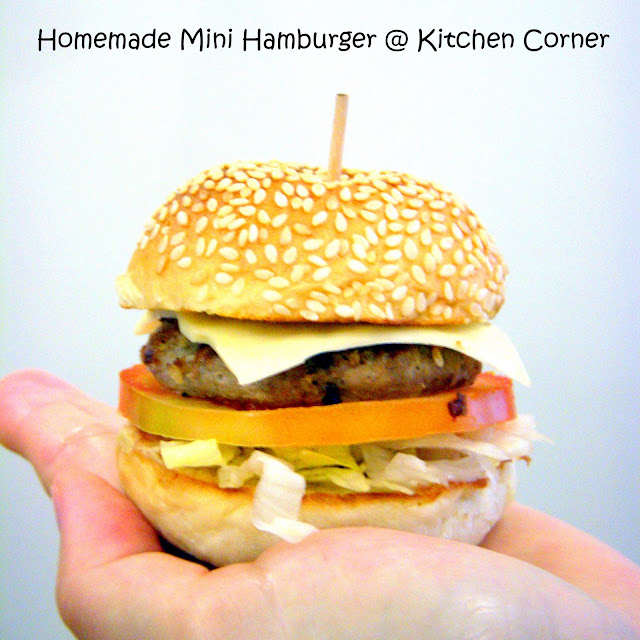
Homemade Hamburger

I make this burger quite often so I thought it would be much easier for me to prepare some for a bloggers meet up last week. The bun and meat actually made ahead of time that sitting in the freezer until I need it. I'm so sorry to Edith as I didn't make extra for her family members. So I post up this recipe here for your reference and for any bloggers that you had tried and like it. Please feel free to make it and remember to make a big batch to freeze it so that you could have homemade hamburger in no time whenever you crave for it. Cheers!
Recipe for the patties:
250g minced pork
250g minced beef
1 big onion, peeled and finely chopped
Olive oil
1/4 teaspoon of cumin powder
1/4 teaspoon fennel powder
1/2 teaspoon coriander powder
some sea salt and ground black pepper
a handful of freshly grated parmesan cheese
a tablespoon Djon mustard
1/2 beaten egg
80g fresh wholemeal breadcrumbs
  1. Fry the onion with some olive oil in a pan for few minutes until softened. When the onion completely cool down, mix it to the meat.
  2. Add the rest of the ingredients and half of the breadcrumbs and mix well. (if the mixture is too sticky, add a few more breadcrumbs)
  3. Shape the meat into the size you like and place on a tray with greaseproof paper.
  4. Sprinkle some bread crumbs on top of each burger and press down gently. Chilled in the fridge for 3-4 hours or in the freezer if not using it immediately.
  5. Fry the burger in a little oil on medium high heat for few minutes, depending on the thickness of the meat.
To assemble the burger, spread some salted butter on the buns and grill it on a griller or pan fry for a few minutes until it slightly turn crisp.
Spread some djon mustard or mayonnaise on the bottom part of the buns and then top with some lettuce. Layer with the meat then follow by cheese kraft and freshly sliced tomato and finally the top part of the buns. Enjoy!


For big burgers, make it into 8 buns and 8 slices of meat or like the party mini burger 20 buns and 20 slices of patties. Some
above pictures shown are big burger in 4 inches diameter size whereas some pictures shown are small in 2 1/2 inches diameter size just like the mini burger sit on my hand. I normally make the buns first then the patties. So that the patties had got the same size with the bun and can be fixed nicely between the buns too as I hardly estimate what size of the dough will expand after proofing.


Recipe for 8 buns (approximately 60g for each dough or make more into small little buns):

210g bread flour / 56g plain flour / 20g milk powder / 42g

caster sugar / half teaspoon of salt / 6g yeast / 30g beaten eggs / 85g water / 84g water dough / 22g unsalted butter

Recipe for the water dough "water roux":
Cook 125g water with 25g bread flour at medium low heat, keep stirring until it become thicken and no lumps left. If you've a candy thermometer, measure it until the temperature turn to 65C then turn of the heat. I didn't measure it with thermometer, so I cook it until quite liquid consistency like the baby porridge. Transfer to a clean bowl to cool down.


Methods:

  • Place all the ingredients for kneading except the butter until everything come together and become a smooth dough then add in the butter a little at a time.
  • Let the dough slowly absorb the butter then turn to speed two if you are using kitchenaid mixer. Knead until the dough no more sticking at the side of the mixing bowl and the dough should be very smooth and elastic.
  • Let it proof for 40 minutes in a clean bowl cover with cling warp.
  • Divide the dough into even size of 8 portions or any size you like it to be then let it rest for 10 minutes.
  • Shape the dough into smooth round shape. Prepare some water on a a clean plate and place a kitchen towel on the top. Damp the surface of each dough and run the damp surface around a bowl of sesame seeds. Place the dough on a baking tray and let the it proof for 40 minutes. Bake at 180C for 15 minutes.

    Energy Star Homes Get New Set of Guidelines


    The Environmental Protection Agency (EPA) has managed the Energy Star labeling program for nearly twenty years, and has helped Americans cut greenhouse gas emissions and save billions on utility costs. In 2009 alone, Energy Star partners helped consumers avoid greenhouse gases in an amount equal to that of the output of 30 million cars and save more than $17 billion on utilities.

    The EPA recently announced a new set of more stringent guidelines for Energy Star-certified home construction. These new conditions will raise the bar of energy efficiency for qualified homes, making them at least 20 percent more efficient than homes built to the previous standards. Homeowners will likely see at least a 15 percent drop in their utility bills, as well.

    The EPA’s updated guidelines will further solidify the Energy Star brand as it’s applied to new home construction. Energy Star homes will continue to represent significant increases in energy efficiency over homes that are built to standard builder practices and codes. The new regulations will go into effect as of January 2011, though many builders and contractors are likely to start implementing the changes much earlier than that.

    If you’re interested in learning more about Energy Star new home construction and how the new guidelines may affect your project, the key components of the revised plan are as follows:
    • Homes must have a complete thermal enclosure system. This includes complete air sealing around windows and doors, adequate insulation around all assemblies, and high performance windows. This not only makes the home more comfortable, but also helps lower utility costs.

    • Comprehensive central heating and cooling systems must meet Energy Star standards and be installed by qualified professionals. Energy efficient heating and cooling systems are designed to increase comfort, offer better moisture control, and operate quietly. They are also outfitted with fresh air ventilation to improve the quality of air inside the home.

    • Because Energy Star homes are so tightly sealed and insulated, they must be equipped with a total water management system. Flashing, moisture barriers, and durable membrane details are all crucial elements in keeping water away from roofs, walls, and foundations. This reduces mold growth, which improves indoor air quality, and extends the durability of these structures.

    • With energy efficient lighting and appliances certified by Energy Star, homeowners can enjoy even more energy savings without sacrificing performance quality.

    • Energy Star and the EPA will now require all new construction to be third party verified by an independent home energy rater. These inspectors will conduct thorough, detailed examinations using specially designed diagnostic tools to measure performance of key systems.

    The new EPA guidelines should come as no surprise to those who make their living building green homes. The revised regulations certainly don’t break much new ground, but they are solid, relatively simple changes that should translate into substantial utility savings while further reducing homeowner’s energy dependence.

    If you are a homeowner considering an Energy Star certified new home construction, you can find out more about the program by visiting http://www.energystar.gov/ or by speaking with an experienced HVAC or home contractor in your area.


    Related Information from Horizon Services...

    Saturday, August 07, 2010

    PANEER CHICKEPEAS CURRY

    This is one of the delicious side dishes for chapathi. Other than white chickpeas, brown small chickpeas are more suitable for this gravy. Chickpeas must be soaked overnight in lots of water. In the morning the water must be drained, washed again twice in lots of water and pressure cooked with enough water before cooking.


    பனீர் கொத்துக்கடலை மசாலா

    Ingredients:

    Paneer- 250 gm
    Small brown chickpeas- 1 cup
    Cumin seeds- half sp
    Curry leaves- 1 arc
    Chopped coriander-half cup
    Turmeric powder- half sp
    Sliced onion-2
    Chopped tomato- 2 cups
    Salt to taste
    Oil- 4 tbsp

    Grind the following ingredients in to a fine paste:

    Small garlic flakes-5
    Shredded coconut- 1 cup
    Fennel seeds- 1 tsp
    Shredded ginger- half sp
    Chilli powder- 1 tsp

    Procedure:

    Soak the paneer pieces in warm water for 20 minutes and then drain the water.
    Soak the chickpeas overnight, discard the water in the morning, pour fresh water and pressure cook them.
    Heat a kadai and pour the oil.
    Add the cumin seeds and when they start to splutter add the onions with the turmeric powder and the tomatoes.
    Cook well until they are mashed and the oil floats on surface.
    Add the greens and cook for a few seconds.
    Add the chickpeas with enough salt and 2 cups of water.
    When the chickpeas are absorbed in the gravy pour the ground paste with the paneer pieces.
    Let the gravy boil for some minutes until it is thickened to desired consistency.
    Hot paneer chickpeas curry is ready for chappathies as well as parottas.